
Red Lake County's Most Wanted Program
A most-wanted program is something a law-enforcement agency chooses to run, not something Minnesota law requires. Where one exists, the office picks a handful of cases, pairs a photo with a short summary, and opens a tip line, sometimes backed by a reward. Many small counties skip the whole thing. Red Lake County is one of them. The county site and the sheriff's pages offer contact details and a mission statement about executing court orders, but no program page, roster, reward schedule, or partner organization appears anywhere on them. Anyone who needs a warrant answer in Red Lake County should work through the court and the sheriff instead of hunting for a program that was never built. A most-wanted page and a warrant file answer different questions anyway, and this county publishes only the second.
No Red Lake County Most Wanted Page Was Located
The county home page, the sheriff's pages, the District Court page, regional corrections, and the three city sites carry no most-wanted list, no wanted-persons gallery, and no case-selection policy between them. So a search engine result promising a Red Lake County wanted list comes from somewhere else. It may be years stale. It may belong to a different jurisdiction entirely, or it may be stitched together from records never meant to be compiled that way. The gap itself is easy to explain: a public roster would run into juvenile privacy law and limits on investigative data, which makes absence the simpler choice for a county this size.
How the Most Wanted Lists Work
Where a program does run, it works as a curated subset rather than a database. The agency picks cases with real public-safety weight, posts a summary, and keeps a tip channel open. Entries get edited and reviewed, and a case sometimes drops off quietly once it resolves. Three assumptions deserve caution. A name on a list means an open case, nothing more. A name left off a list can still carry an active warrant. And a listing can linger after the underlying case changes, because a web page updates on the publisher's schedule, not the court's. That distinction matters in Red Lake County too: most-wanted entries earn their spot through publicity, while a warrant file exists for every open warrant whether anyone publicizes it or not.
Minnesota DOC Wanted Fugitives: A Supervision Program
The nearest statewide program answers a different question. The Minnesota Department of Corrections wanted fugitives page lists people who have violated conditions of state community supervision. Those are supervision violations, not local bench warrants, and the program runs its own tip routes. A Red Lake County case that started with a citation or a complaint belongs to the District Court, even when the same person also has a supervision file on the state side. The state page does what it does well. It is no substitute for a county warrant check.
The program page describes supervision violations, while Red Lake County warrants stay in local hands at the District Court.
Reporting a Tip Safely
A tip only helps when it reaches an agency that can act on it, not a social feed. Emergencies belong with 911. Everything else goes to the office that published the program, or in Red Lake County to the sheriff.
Key Points:
Call 911 when a situation is in progress, when someone is in danger, or when a person is being followed or confronted.
Use the published tip channel for a program that actually maintains a list, and read its instructions before sending information.
Do not investigate, approach, photograph, or follow anyone yourself, and do not post a name or a photo to a public group.
For anything tied to a Red Lake County matter, the Sheriff's Office at 218-253-2996 takes the call. The office can point a caller to the right channel.
The North Star Fugitive Task Force and Federal Warrants
Federal fugitive work sits on a third layer. The U.S. Marshals Service district page describes the North Star Fugitive Task Force and posts district contact numbers. Federal warrants come from the U.S. District Court for the District of Minnesota, and they are not filed in Red Lake Falls. Access runs through the federal court clerk and the federal records system. The federal court warns that some warrants stay sealed until a judge unseals them. Anyone holding a federal notice should use the federal channels or a lawyer, while a Red Lake County bench warrant remains a state matter.
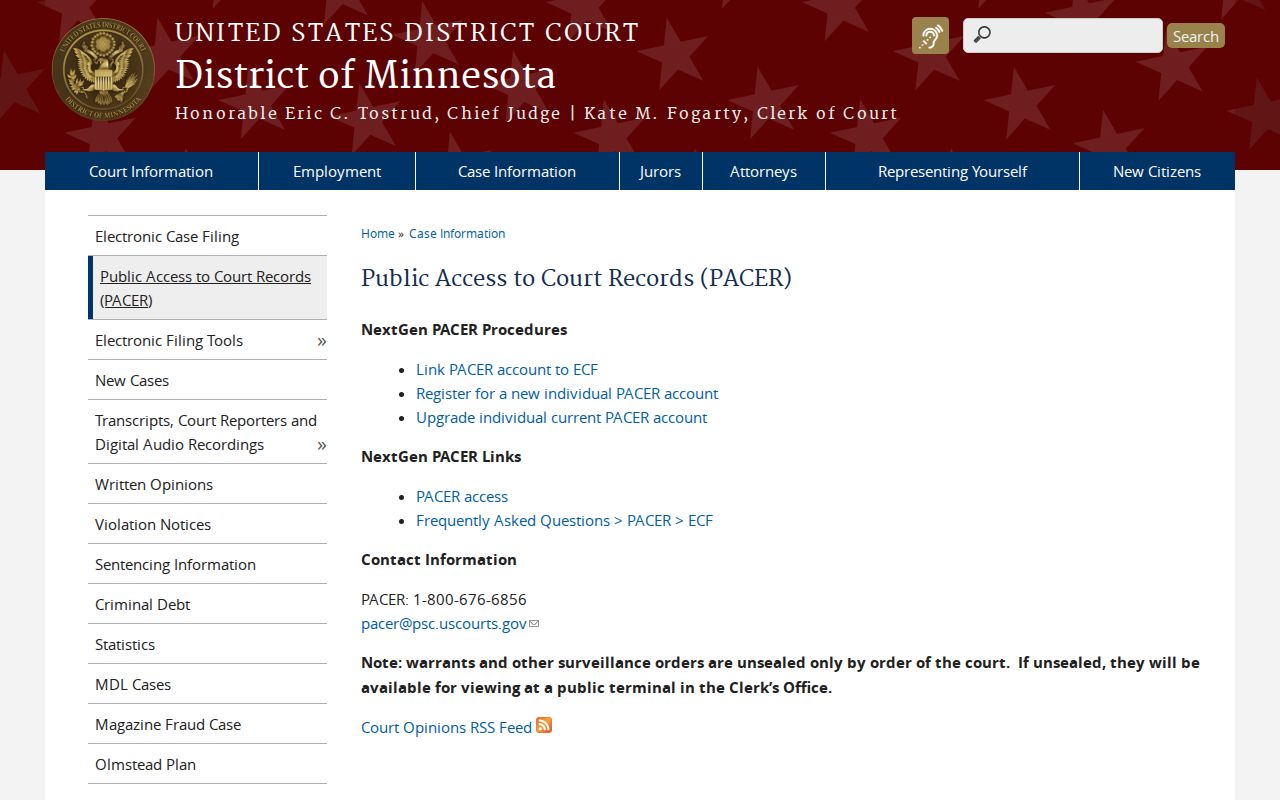
The federal page lays out the access route, and it also explains why a federal record can be sealed even when it exists. A Red Lake County warrant, by contrast, stays a state-court question.
Most Wanted Lists vs Active Warrants
Two products, two purposes, and mixing them up produces bad conclusions.
| Point | Most Wanted List | Active Warrant |
|---|---|---|
| Who controls it | The publishing agency, which selects cases | The court, which issues the order |
| How complete it is | Selective and temporary | One entry per open warrant in a file |
| What absence means | Nothing about whether a warrant exists | Not applicable; the file either shows one or does not |
| Who can confirm | The publishing program | Court Administration |
Why Rosters Are Not Republished Here
A most-wanted roster can go stale the day it is copied. Red Lake County law enforcement updates its own publications and pulls entries when a case is resolved. A copy of that list keeps floating around with no way to be corrected. That alone is reason enough to leave the original where it lives. Minnesota law adds another layer, drawing a line between public and nonpublic data and shielding juvenile information. There is a deeper problem, too. A name on a list looks like an ending, but an active warrant is not an ending. It is an order a judge signed, and only the issuing court can say what it means today. The answer sits in the court file, not in any mirror of it.
If You Think You Are on a List
Finding a notice with your name on it is the moment to slow down. Call Red Lake County Court Administration and ask what the file actually says. A lawyer can then explain how each option shapes the case.
Important: Contact the court or a lawyer, and do not approach a person, a scene, or an officer based on a page anyone else published.
Red Lake County warrant records, including the questions to ask and how to appear, are gathered on the county warrant records home page. Start there.
What Red Lake County Publishes Instead
What Red Lake County publishes is not a list but the tools for checking one case. The sheriff's phone and address, the District Court contact block with business hours, the weekly public calendar, and the regional corrections contact all sit on official pages. Each one answers a different question. The sheriff knows which agency serves a warrant and how execution works. The court knows what the judge signed and what happens next. The corrections center in Crookston knows who is in custody and how release works. So pick the right office for your question. Have a case number ready before you dial. One call to the correct office beats an hour spent scrolling a roster that cannot tell you your status anyway.